Hydration and the Brain: Why Fluid Balance Matters in Contact Sport
In this article8 sections
What the research actually shows about fluid loss and thinking, where the meaningful threshold sits, and why hydration is worth getting right without being oversold.
Hydration and the Brain
Fluid loss affects how athletes think and feel, but the research suggests the effect becomes consistent at larger deficits, in the range of 3 to 5 percent of body mass, rather than at the mild dryness most people call being thirsty. That is worth knowing in both directions: hydration is genuinely worth managing, and it is also routinely oversold.
For athletes in contact sport, where the brain is already being asked to do demanding work, it is one of the few variables that is cheap, measurable and completely within your control.
What the research actually found
A systematic review of 24 trials covering 493 participants looked at hypohydration, the technical term for being meaningfully low on fluid, and cognitive performance in athletes. The conclusion was specific: hypohydration was associated with impaired cognitive performance and mood at higher levels of 3 to 5 percent body mass loss. At more modest losses, around 2 percent or below, the picture across studies was inconsistent.
Alongside that, mood disturbance, fatigue and ratings of perceived exertion consistently travelled with the cognitive effects, which suggests these things interact rather than acting independently. An athlete who is low on fluid is not just marginally slower on a test, they are tireder, flatter and finding the same work harder.
Going the other direction, a separate systematic review and meta-analysis looked at what happens when you drink after becoming dehydrated. The honest summary is that the cognitive benefit was inconsistent across the trials, while mood improved more reliably: four of six trials examining mood found meaningful positive effects, including reductions in fatigue. The authors were candid that the influence of fluid intake on mood and thinking is still poorly understood and needs more research.
What that means in practice
Three things follow, and none of them are dramatic.
The threshold is real, and most athletes cross it more often than they think. Three to five percent of body mass is roughly 5 to 9 pounds for a 180 pound athlete. That sounds like a lot until you have watched someone play a full match in August heat.
Mild thirst is not an emergency. The evidence does not support the idea that being slightly under-hydrated meaningfully dulls thinking. Treating every dry mouth as a crisis is how people end up overcorrecting, which carries its own problems.
Mood and perceived effort move first. If an athlete is flat, irritable and finding a normal session unusually hard, fluid status is a reasonable thing to check before reaching for more complicated explanations.
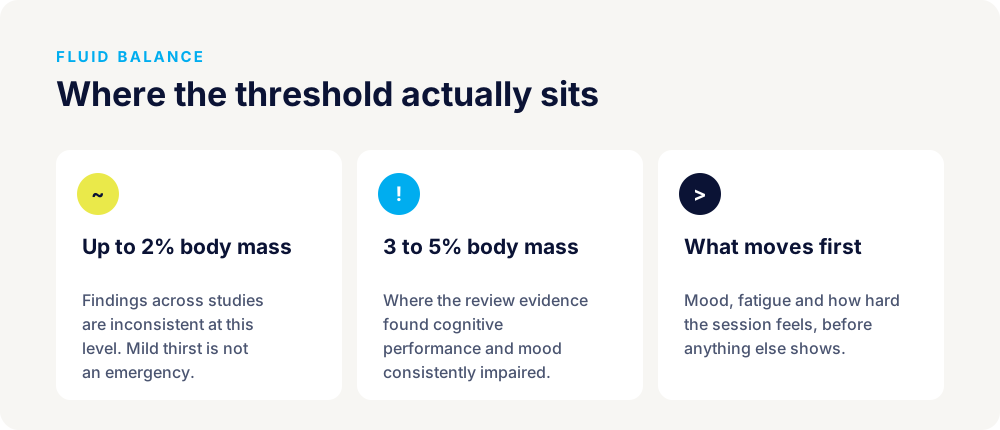 Where the evidence actually draws the line.
Why it matters more in contact sport
None of the research above is about head impacts. It is about hydration and cognition generally, and it should be read that way rather than stretched.
The reason it still belongs in a conversation about contact sport is situational. An athlete deep into a hot session is being asked to make fast decisions, track moving people, and judge when to protect their own head, at exactly the point they are most likely to be carrying a fluid deficit and feeling the fatigue that comes with it. Hydration does not make anyone impact-proof. It removes one avoidable handicap from a moment that already asks a lot, which is the same logic behind head impact support generally.
It also matters afterwards. An athlete working back through a staged return to activity, which we cover in return to play after a head impact, is doing real graded physical work under supervision. Turning up to those sessions under-hydrated muddies the one signal the progression depends on: whether increased exertion is being handled well.
A hydration routine that does not require a spreadsheet
- Start the day ahead, not at the field. Most deficits are inherited from the hours before the session, not created during it.
- Drink on a schedule during long or hot sessions, rather than waiting for thirst, which lags behind actual fluid loss.
- Weigh before and after for a week if you want a real number. The difference is mostly fluid, and it tells you far more than any general guideline about how much this particular athlete loses.
- Replace afterwards, with fluid and with food that contains sodium. Water alone with nothing else is not the best replacement after heavy sweating.
- Watch the flat days. Fatigue and low mood arriving together, with an unremarkable session, is a reasonable prompt to check fluid before anything else.
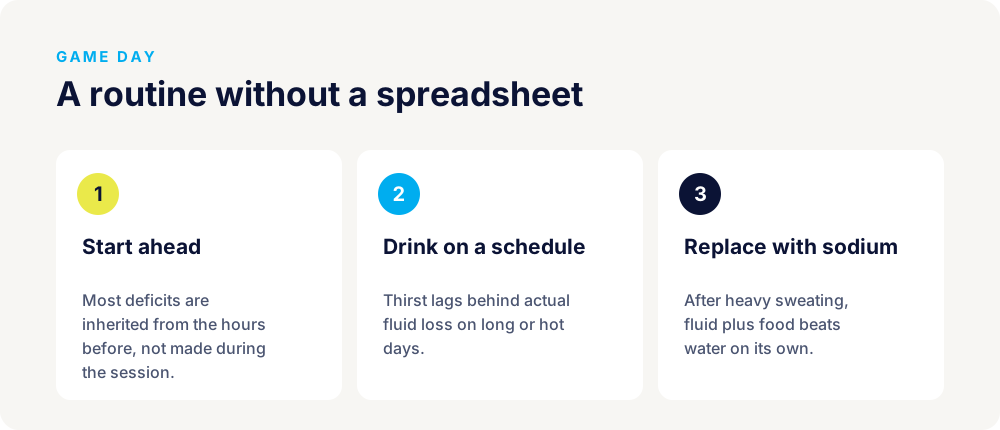 The whole routine, without a spreadsheet.
Where OnHand fits, and where it does not
OnHand is a powder mixed into water and taken around higher risk activity, so it arrives alongside fluid rather than instead of it. The blend contains eleven actives selected for their studied roles in the brain's ordinary energy, repair and inflammatory processes.
What it is not is a rehydration product or an electrolyte replacement, and it should not be treated as either. An athlete who needs fluid and sodium after a hot session needs fluid and sodium.
Important: hydration is basic care, not a safeguard
Being well hydrated is ordinary good practice. It does not make a head impact safer, it does not shorten recovery from one, and it is not a substitute for sport safety protocols or medical evaluation.
OnHand is a wellness product made to support the brain's ordinary readiness and recovery processes around activity. It does not diagnose, treat, cure or prevent concussions or any other condition. If a head injury is suspected, stop the activity and seek prompt medical evaluation. Do not use OnHand to make return-to-play, return-to-work, or return-to-activity decisions.
Frequently asked questions
Does dehydration affect how well you think? Research in athletes found cognitive performance and mood were impaired at larger fluid deficits, around 3 to 5 percent of body mass loss. At more modest losses of around 2 percent or less, findings across studies were inconsistent.
How much fluid loss is significant for an athlete? The review evidence points at 3 to 5 percent of body mass as where cognitive effects become consistent, particularly alongside heat stress and limited fluid intake. For a 180 pound athlete that is roughly 5 to 9 pounds.
Does drinking after dehydration restore thinking right away? Not reliably, on current evidence. A meta-analysis found inconsistent cognitive benefits from rehydration, while mood improved more consistently, including reduced fatigue. The authors noted this area still needs more research.
Is water enough after a hot session? After heavy sweating, fluid plus sodium, usually through food, replaces losses better than water alone.
Does hydration help after a head impact? Being hydrated supports how anyone feels and functions generally, and it is sensible care. It is not a treatment for a head injury and does not change the staged return to activity, which is set by a healthcare professional.
The takeaway
Hydration is worth doing properly and not worth mythologising. The evidence says big deficits matter and small ones probably do not, that mood and perceived effort are the earliest tell, and that drinking afterwards helps how you feel more reliably than it sharpens how you think. Start the day ahead, drink on a schedule when it is hot, and replace what you lost. That is the whole skill.
Learn more about the readiness ritual at keeponhand.com, or explore doctor-vetted recovery resources at myconcussiondr.com.
Sources
- Dube, A., Gouws, C., & Breukelman, G. (2022). Effects of hypohydration and fluid balance in athletes' cognitive performance: a systematic review. African Health Sciences, 22(1), 367-376. https://pmc.ncbi.nlm.nih.gov/articles/PMC9382508/
- McCartney, D., Desbrow, B., & Irwin, C. (2017). The Effect of Fluid Intake Following Dehydration on Subsequent Athletic and Cognitive Performance: a Systematic Review and Meta-analysis. Sports Medicine - Open, 3, 13. https://pmc.ncbi.nlm.nih.gov/articles/PMC5357466/
- Centers for Disease Control and Prevention. What to Do After a Concussion. HEADS UP. https://www.cdc.gov/heads-up/guidelines/recovery-from-concussion.html
This article is for general education and wellness information only. It is not medical advice and does not diagnose, treat, cure, or prevent any condition. Consult a qualified healthcare professional for concerns about head injuries.
Medically reviewed by MyConcussionDr medical team. This article is for general information and is not medical advice. Anyone with a suspected head injury should be evaluated by a licensed provider.

Start your readiness ritual
One minute a day. Keep it nearby.