Return to Play After a Head Impact: How the Six Steps Actually Work
In this article8 sections
The staged return to sport progression, explained step by step: what each stage involves, why 24 hours is the minimum, and what happens when signs come back.
Return to Play After a Head Impact
Return to play is a staged progression, not a date on a calendar: six steps, a minimum of 24 hours at each one, with a healthcare professional signing off before full contact. The athlete advances only if the step they are on does not bring their signs back. If it does, they drop back a stage.
That structure exists because feeling fine and being ready are not the same thing, and because the cost of getting it wrong falls on the one person in the conversation with the least perspective on it. Here is what each step actually involves and where the decisions sit.
Where the progression starts, and where it does not
The progression does not start on the day of the impact. It starts after the initial window, which is its own separate thing. For roughly the first 24 to 48 hours the guidance is relative rest: reduced physical and mental load, reduced screens, gentle movement, and normal sleep. We covered that window in detail in the first 48 hours after a head impact.
It also does not start on the athlete's say so. Step one is entering the progression at all, and the CDC is direct about the gate: an athlete should only return to sports practices with the approval and under the supervision of their healthcare provider.
One more thing that is easy to miss. Return to learn generally comes before return to play. Getting back to a full school or work day without things getting worse is the practical evidence that the brain is handling ordinary cognitive load again. Sending someone back to contact while they still cannot sit through a class is putting the harder test first.
The six steps
This is the progression the CDC publishes, built on the international consensus guidelines. Each step typically takes a minimum of 24 hours, and the athlete moves up only if the current step produced no new signs.
Step 1: Back to regular activities
The athlete is back to their normal day, school or work included, and has clearance from their healthcare provider to begin the progression. No sport yet. This step is the baseline that makes the rest of it readable.
Step 2: Light aerobic activity
Light exercise to raise the heart rate and nothing more. Five to ten minutes on a stationary bike, a walk, an easy jog. No resistance training. The purpose is to find out how the brain handles a modest increase in exertion in the most controlled way available.
Step 3: Moderate activity
Heart rate up further, and now with body and head movement. Moderate jogging, brief running, moderate intensity lifting, sport-specific drills without any contact risk. This is the last step before things get genuinely physical, and it is also the step the athlete returns to if anything goes wrong higher up.
Step 4: Heavy, non-contact activity
Sprinting, running, full intensity conditioning, more demanding drills. Everything the sport asks for except other people. By the end of this step the athlete has been tested at close to competition load with no impact risk.
Step 5: Practice and full contact
Return to normal training, including full contact if the sport involves it. This is the first step where another head impact becomes possible again, which is exactly why it sits this far along.
Step 6: Competition
Back to playing.
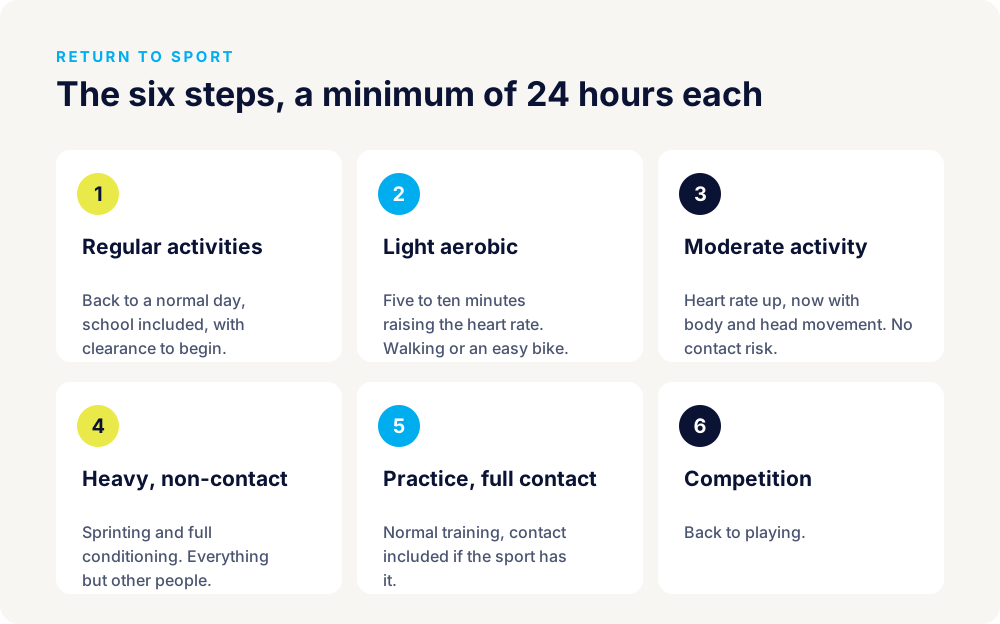 The six steps, in order. Each one takes a minimum of 24 hours.
The rules that make the steps work
The list is the easy part. These three rules are what the progression actually is.
A minimum of 24 hours per step. Not an average, a floor. Six steps therefore means a minimum of about a week even for an athlete who sails through, and that is the fastest realistic version, not the expected one.
Signs returning means going back. Under the current consensus, if concussion-related signs appear during the later steps, the athlete returns to step 3 to re-establish that they can handle exertion without trouble before going near at-risk activity again. Not "push through it", not "try again tomorrow at the same level". Back down.
A healthcare professional clears full return. The consensus asks for a written determination of readiness before unrestricted return to sport. The athlete does not make that call. Neither does the coach, and neither does the parent.
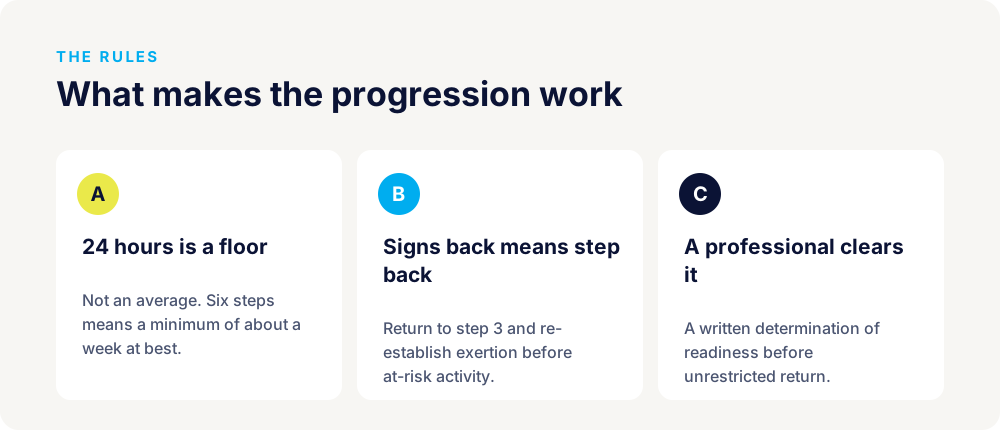 The list of steps is the easy part. These three rules are the progression.
Why the timeline resists being rushed
Most children recover within a few weeks with appropriate care, and most athletes get through this progression without drama. So why the formality?
Because the risk is concentrated in exactly the window where people feel fine. The brain is most vulnerable to another impact while it is still recovering from the first, and there is no visible marker that tells you when that window closes. The progression is a way of testing the brain under increasing load in a setting where a bad answer costs an athlete a day, rather than in a setting where it costs them another impact.
There is also the longer arc. Research on repeated smaller impacts, the routine hits that never produce obvious signs, suggests they may have cumulative effects on brain structure and function across a season of contact sport. An athlete rushed back early is not only exposed to one badly timed collision, they are adding load to a brain that has not finished dealing with the last lot. We wrote more about that in head impacts in youth sports.
What families can control between steps
Most of this progression is out of a family's hands. It is clinician led and it moves at the speed it moves. What is in their hands is the ordinary stuff around it, and that is worth doing well rather than anxiously.
Sleep is the big one. Irregular sleep timing, particularly inconsistent bedtimes, has been associated with slower recovery in adolescent athletes after concussion. A steady bedtime is free, it is entirely within a household's control, and on the current evidence it is the highest value habit in this whole list.
Hydration affects how anyone feels and performs, and an athlete working back through graded exertion is doing real physical work.
Food matters in the ordinary way food matters. A brain doing repair work is better served fed than not. Several nutrients including omega-3 fatty acids and magnesium have studied roles in the brain's normal energy, repair and inflammatory processes, and that research is still developing. It is a supporting role around clinical care, and nothing in it changes a step or shortens the progression.
Important: nothing here is a shortcut
No food, habit or product moves an athlete through these steps faster, and anything marketed as if it does should be treated with suspicion. The progression is paced by how the brain responds to load, and that is measured by a clinician, not accelerated by a purchase.
OnHand is a wellness product made to support the brain's ordinary readiness and recovery processes around activity. It does not diagnose, treat, cure or prevent concussions or any other condition. If a head injury is suspected, stop the activity and seek prompt medical evaluation. Do not use OnHand to make return-to-play, return-to-work, or return-to-activity decisions.
Frequently asked questions
How long does return to play take after a concussion? A minimum of about a week, because the progression has six steps and each typically takes at least 24 hours. In practice it often takes longer, because any return of signs sends the athlete back a stage. Most children recover within a few weeks with appropriate care.
Can an athlete return to play the same day as a head impact? No. An athlete with a suspected concussion is removed from play and does not return the same day, no matter how quickly they report feeling fine.
What are the six return to play steps? Back to regular activities, light aerobic activity, moderate activity with body and head movement, heavy non-contact activity, practice and full contact, then competition. Each step typically takes a minimum of 24 hours.
What happens if signs come back during the progression? The athlete steps back, and under the current consensus returns to step 3 to confirm they can handle exertion without trouble before moving toward at-risk activity again.
Who decides when an athlete can play again? A healthcare professional. The consensus asks for a written determination of readiness before unrestricted return to sport. It is not a decision for the athlete, the coach or the family.
Does return to learn come before return to play? Generally yes. Handling a full school or work day without things getting worse is the practical evidence that the brain is managing ordinary cognitive load, and that comes before adding physical and contact load on top.
The takeaway
The six steps look bureaucratic from the outside and feel slow from the inside, which is precisely the point. They convert an invisible question, is this brain ready, into a series of small visible tests with a day between each one. The athlete who respects the progression loses a week. The athlete who skips it is gambling with something that does not offer a rematch.
Learn more about the readiness ritual at keeponhand.com, or explore doctor-vetted recovery resources at myconcussiondr.com.
Sources
- Centers for Disease Control and Prevention. Returning to Sports. HEADS UP. https://www.cdc.gov/heads-up/guidelines/returning-to-sports.html
- Centers for Disease Control and Prevention. Managing Return to Activities. HEADS UP Clinical Guidance. https://www.cdc.gov/heads-up/hcp/clinical-guidance/index.html
- Nakayama, H., Hiramoto, Y., & Iwabuchi, S. (2024). A Perspective on the 6th International Conference on Sports Concussion. Brain Sciences, 14(5), 515. https://pmc.ncbi.nlm.nih.gov/articles/PMC11119671/
- Donahue, C., Wingerson, M., Kniss, J., Richardson, K., Hurlburt, K., Simon, S., Wilson, J., & Howell, D. (2026). Consistency Is Key: Irregular Sleep Timing and Delayed Recovery Following Adolescent Concussion. Orthopaedic Journal of Sports Medicine, 14(6 suppl 5). https://pmc.ncbi.nlm.nih.gov/articles/PMC13283534/
- Uncovering the hidden effects of repetitive subconcussive head impact exposure: a mega-analytic approach. (2024). Human Brain Mapping. https://pmc.ncbi.nlm.nih.gov/articles/PMC11345636/
This article is for general education and wellness information only. It is not medical advice and does not diagnose, treat, cure, or prevent any condition. Consult a qualified healthcare professional for concerns about head injuries.
Medically reviewed by MyConcussionDr medical team. This article is for general information and is not medical advice. Anyone with a suspected head injury should be evaluated by a licensed provider.

Keep it on hand.
Pack it before the game. Mix it after a hit.