Sleep After a Head Impact: What Athletes and Parents Should Know
In this article8 sections
No, you do not need to wake them through the night. What current guidance says about sleep after a head impact, and why a consistent bedtime matters more than total hours.
Sleep After a Head Impact
You do not need to wake someone up through the night after a head impact, and current guidance says to let them sleep as usual with a normal bedtime routine. The advice most parents remember, hourly wake-ups through the night, has been superseded. What matters now is watching for danger signs, and then protecting sleep rather than interrupting it.
This is one of the few areas of head impact recovery where a family has real control, and it may be one of the more consequential.
Where the wake-them-up advice came from
The old advice was not superstition. It came from a genuine concern: a bleed inside the skull can develop in the hours after a head injury, and an unconscious person cannot tell you they are getting worse. Waking someone hourly was a crude way of checking.
The guidance changed because the checks turned out to be the wrong tool. Bleeding of that kind announces itself through danger signs, not through sleep itself, and repeatedly interrupting sleep costs the brain something real at exactly the moment it is doing recovery work. CDC guidance is now direct: let your child sleep as usual, and keep a set bedtime routine.
The important qualifier is that this applies after danger signs have been ruled out. If any of these appear, at any hour, that is emergency care and not a sleep question:
- One pupil larger than the other
- Drowsiness, or an inability to wake up
- A headache that keeps getting worse
- Slurred speech, weakness, numbness, or loss of coordination
- Repeated vomiting, convulsions, or seizures
- Increasing confusion, restlessness, or agitation
The full sequence for that window is in the first 48 hours after a head impact.
Why sleep is worth protecting
Sleep disturbance after a head impact is common rather than unusual, and it tracks with how recovery goes.
Research following adolescents after concussion found that insomnia signs at the start were associated with a more difficult course at three weeks and three months. Sleep duration and daytime sleepiness improved gradually over the first three weeks, but insomnia itself stayed put through that acute period and only fell away meaningfully by the three month mark.
That finding cuts two ways. It means trouble sleeping in the first weeks is common and not in itself a reason to panic. It also means sleep is worth taking seriously as a thing to support, not just a thing to measure.
Consistency appears to beat duration
Here is the finding that is most useful to a household, because it is actionable in a way that "get more sleep" is not.
A 2026 study of adolescent athletes after concussion looked at how variable their sleep timing was, and found that bedtime irregularity specifically, rather than wake time variability or variability in total sleep duration, was what tracked with slower recovery. Each 10 percent increase in that irregularity corresponded to substantially higher odds of signs persisting beyond 28 days.
Read carefully, that is an association in a single study, not a proven cause, and it should not be oversold. But the practical implication costs nothing to act on: a steady bedtime is free, it is entirely inside a family's control, and the evidence pointing at it is at least pointing in a consistent direction.
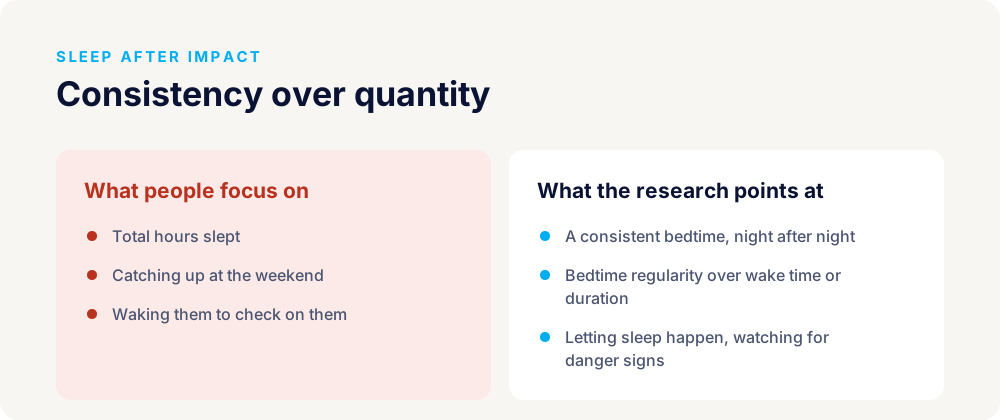 Where attention usually goes, and where the evidence points instead.
What a sleep-protective week actually looks like
Nothing exotic. The list is short on purpose.
- A fixed bedtime, including at weekends. This is the one the research points at most directly.
- Screens down before bed, which also lines up with the reduced screen load advised in the first day or two anyway.
- No sleep medication without asking their doctor first. CDC is explicit about this.
- Let the naps happen in the early days if they need them, while keeping the night anchor fixed.
- Note the pattern. When they went down, when they woke, how the next day went. Three lines in a phone note is enough, and it gives the clinician something real to work with.
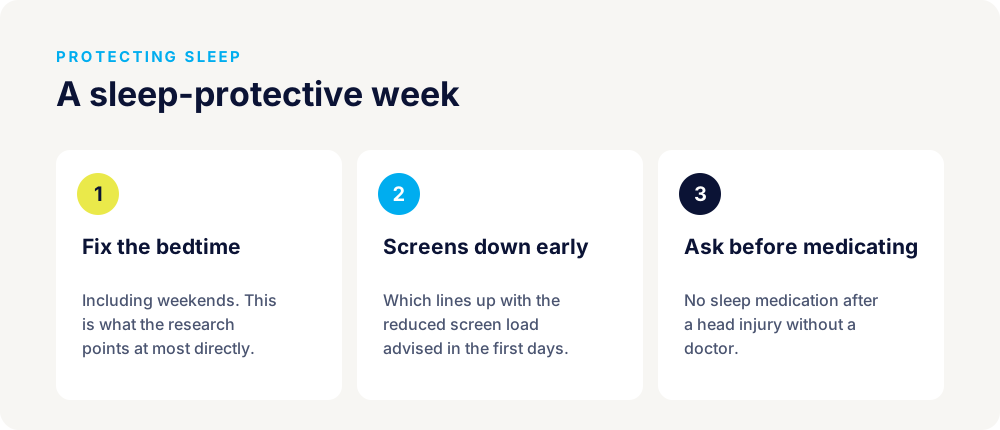 Three habits, all free, all inside a household’s control.
Where food and hydration fit
Lightly, and honestly. Being hydrated and reasonably fed supports how anyone feels and functions, and an athlete who came off a hot field dehydrated is starting the night at a disadvantage.
Several nutrients including omega-3 fatty acids and magnesium have studied roles in the brain's ordinary energy, repair and inflammatory processes, and that literature is still developing. None of it makes a nutrient a sleep aid or a recovery treatment, and none of it substitutes for the bedtime.
If you want the fuller picture on the nutrition side, we went through it in nutrients for brain recovery.
Important: sleep is supportive care, not a treatment
Protecting sleep is good general care. It does not diagnose anything, it does not treat a head injury, and it is not a reason to skip or delay professional evaluation. Persistent trouble sleeping after a head impact is worth raising with a clinician rather than managing alone.
OnHand is a wellness product made to support the brain's ordinary readiness and recovery processes around activity. It does not diagnose, treat, cure or prevent concussions or any other condition, and it is not a sleep product. If a head injury is suspected, stop the activity and seek prompt medical evaluation. Do not use OnHand to make return-to-play, return-to-work, or return-to-activity decisions.
Frequently asked questions
Should you wake someone up after a head injury? No. Current CDC guidance is to let them sleep as usual and keep a normal bedtime routine, once danger signs have been ruled out. The hourly wake-up advice has been superseded. Danger signs, not sleep, are what require emergency care.
Is it normal to have trouble sleeping after a head impact? Yes. Sleep disturbance is common after concussion. Research in adolescents found insomnia signs tended to persist through the first three weeks before easing by around three months. Persistent trouble is worth raising with a clinician.
Does a consistent bedtime help recovery? A 2026 study of adolescent athletes found that irregular bedtimes, more than variable wake times or sleep duration, were associated with a higher chance of signs persisting beyond 28 days. It is an association rather than proof, but a steady bedtime costs nothing.
Can you take sleep medication after a concussion? Not without asking a doctor. CDC guidance specifically advises against giving sleep medication after a head injury without medical guidance.
How much sleep does someone need after a head impact? There is no special number. Normal sleep for their age, at a consistent time, is the guidance. Extra rest in the first day or two is fine if they need it.
The takeaway
Let them sleep, watch for danger signs rather than watching the clock, and keep the bedtime the same on Saturday as on Tuesday. It is the least dramatic advice in head impact recovery and quite possibly the most useful part a family actually controls.
Learn more about the readiness ritual at keeponhand.com, or explore doctor-vetted recovery resources at myconcussiondr.com.
Sources
- Centers for Disease Control and Prevention. What to Do After a Concussion. HEADS UP. https://www.cdc.gov/heads-up/guidelines/recovery-from-concussion.html
- Tham, S. W., Aaron, R., & Palermo, T. M. (2019). The Role of Sleep Deficiency in the Trajectory of Postconcussive Symptoms in Adolescents. Brain Injury, 33(11), 1413-1419. https://pmc.ncbi.nlm.nih.gov/articles/PMC7243849/
- Donahue, C., Wingerson, M., Kniss, J., Richardson, K., Hurlburt, K., Simon, S., Wilson, J., & Howell, D. (2026). Consistency Is Key: Irregular Sleep Timing and Delayed Recovery Following Adolescent Concussion. Orthopaedic Journal of Sports Medicine, 14(6 suppl 5). https://pmc.ncbi.nlm.nih.gov/articles/PMC13283534/
- Centers for Disease Control and Prevention. Responding to a Sports-related Concussion. HEADS UP. https://www.cdc.gov/heads-up/response/index.html
This article is for general education and wellness information only. It is not medical advice and does not diagnose, treat, cure, or prevent any condition. Consult a qualified healthcare professional for concerns about head injuries.
Medically reviewed by MyConcussionDr medical team. This article is for general information and is not medical advice. Anyone with a suspected head injury should be evaluated by a licensed provider.

Start your readiness ritual
One minute a day. Keep it nearby.